

What makes a Cambodian dessert memorable may be its texture as much as its sweetness. If you’re searching for cambodian dessert melbourne, unfamiliar names and ingredients can make choosing feel like a leap. At ANGKOR Cambodian Flavours in West Melbourne, Black Rice Pudding is a welcoming place to begin: black rice, coconut cream and sesame seeds come together in a bowl that’s creamy, gently chewy and softly nutty.
More than a list of dishes, a useful guide can help you know what to notice when you take that first taste. Consider how the textures meet, whether the sweetness suits you and how dessert fits into a meal. Chef Neri’s cooking is inspired by her Cambodian family heritage, bringing a personal connection to the table.
This guide introduces the variety of Khmer sweets, explains what to expect from Black Rice Pudding and offers practical ways to choose a first taste. You don’t need to know every name before you sit down to enjoy a Cambodian meal in West Melbourne.
Key Takeaways
- Cambodian sweets vary in sweetness and texture, so approach each dessert on its own terms.
- Black Rice Pudding combines black rice, coconut cream and sesame seeds for a creamy, chewy and softly nutty taste.
- Use your sweetness preference, preferred texture and meal setting to guide your first choice.
- ANGKOR Cambodian Flavours in West Melbourne serves Black Rice Pudding as part of its dine-in Cambodian meals.
- Tasting dessert alongside a meal can help you appreciate how a sweet fits into the wider dining experience.
What makes Cambodian dessert distinctive in Melbourne?
Cambodian desserts are a varied part of Khmer food culture, not a single style defined by one ingredient or level of sweetness. Rice-based and fruit-based sweets, puddings and custards are among the forms described in Cambodian cuisine on Wikipedia. Each offers a different way to bring sweetness, texture and aroma to the table.
Khmer desserts vary in flavour and texture, so there’s no one taste that represents them all. That’s a useful starting point if you’re exploring cambodian dessert melbourne. Rather than expecting every dish to taste alike, consider each one on its own terms. A soft pudding, a chewy rice dessert and a fruit-led sweet can make very different first impressions.
How do Khmer sweets balance flavour and texture?
There isn’t one universal Khmer dessert profile. Some sweets may feel creamy or soft; others are valued for a chewy bite or a fragrant finish. Sweetness also varies from one dessert to another. Texture matters just as much as flavour, so notice how each mouthful feels as well as what you taste.
For a first-time diner, this variety is part of the pleasure. Take a moment to notice the details: a smooth spoonful, a little chew or an aroma that lingers. These simple observations help you explore without assuming that one dessert represents them all.
Why do family memories matter at the dessert table?
Food traditions often take shape through family cooking and shared meals. Recipes and customs can differ between households and regions, so no single family’s way of serving a sweet represents everyone. Still, the table can connect a dish with familiar tastes, careful preparation and time spent together.
At ANGKOR Cambodian Flavours in West Melbourne, Chef Neri’s cooking is inspired by her Cambodian family heritage. The restaurant serves Black Rice Pudding as a traditional Khmer dessert alongside dine-in meals. It’s a local way to experience a Khmer sweet as part of a Cambodian meal, while recognising that one restaurant’s expression is not the whole story.
That context can make Melbourne’s Cambodian food scene easier to explore. A general description introduces dessert styles, while tasting a dish gives you your own sense of how its texture and flavour come together. Go slowly, notice what you enjoy and let curiosity guide your next taste. You don’t need to know every name in advance; understanding that Khmer sweets vary is a useful first step.
Cambodian dessert styles to know before you explore
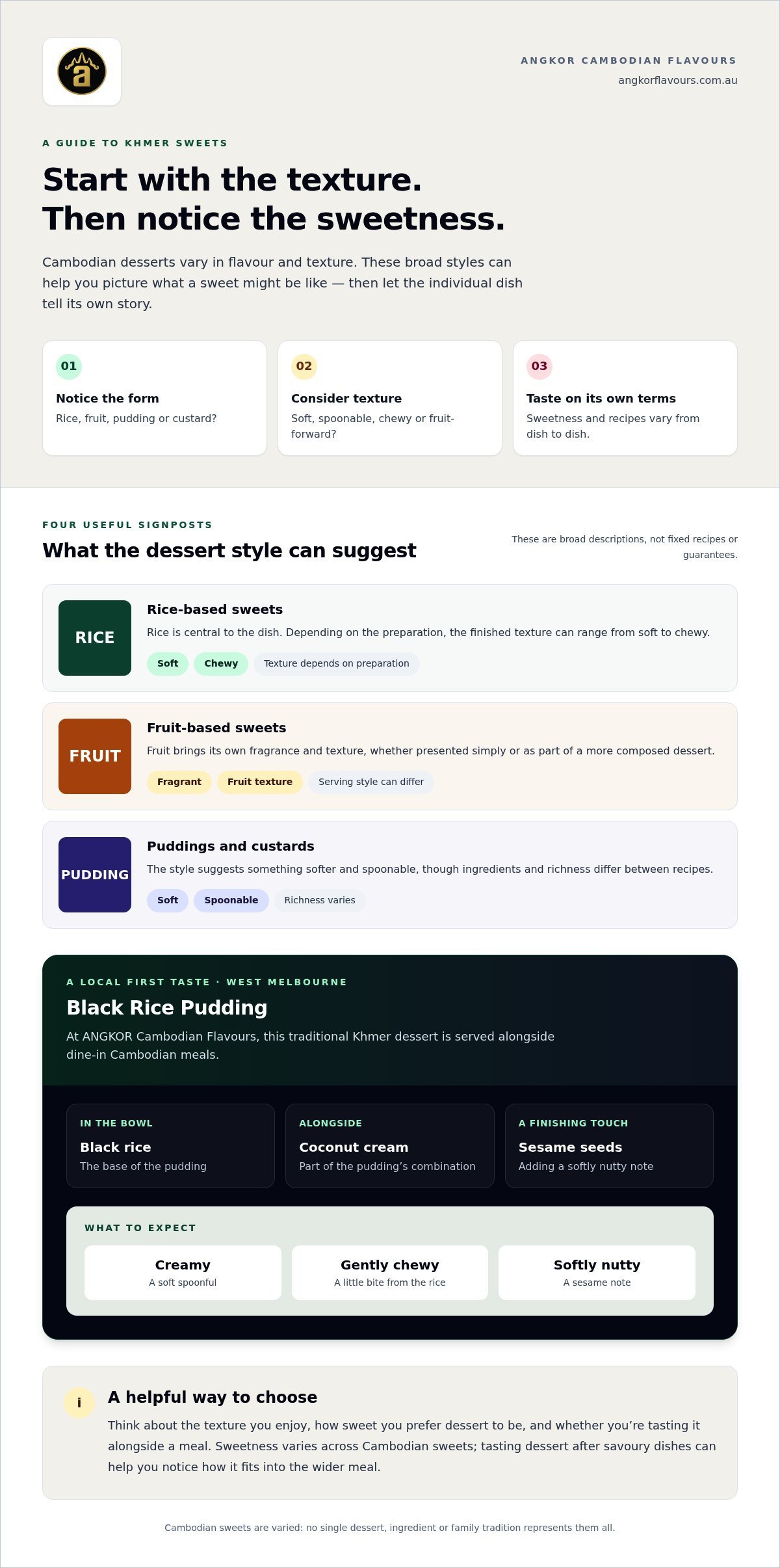
Khmer sweets aren’t one fixed collection of recipes. To get your bearings, start with the form of a dessert: is it based on rice or fruit, or is it a soft pudding or custard? These broad groups are signposts, not rules. Recipes and serving customs vary, and a dish’s name alone won’t tell you exactly how sweet or textured it will be.
For people searching for cambodian dessert melbourne, it helps to distinguish general examples of Cambodian sweets from the dessert served at a particular restaurant. At ANGKOR Cambodian Flavours, Black Rice Pudding is served as a traditional Khmer dessert with dine-in meals. The other forms below offer context about the wider dessert landscape.
How can readers recognise different Cambodian sweets?
Start with the main ingredient and the way the dessert is served. Broad descriptions of Cambodian cuisine include rice-based and fruit-based sweets, as well as puddings and custards. These categories can help you picture a dish, but they don’t describe one standard recipe. Look for clues about texture and serving style, then judge the individual dessert by what you taste.
- Rice-based sweets: Rice is central to the dish, though the finished texture can range from soft to chewy depending on the preparation.
- Fruit-based sweets: Fruit brings its own fragrance and texture, whether presented simply or as part of a more composed dessert.
- Puddings and custards: These suggest a softer, spoonable style, though ingredients and richness differ between recipes.
These are broad descriptions, not a checklist of ingredients. Not every Cambodian dessert uses coconut, and not every sweet is served warm or tastes alike. If you’re looking at a menu for the first time, decide what sounds inviting: tender, creamy, chewy or fruit-forward. Choosing by texture can make unfamiliar options feel more approachable.
What makes Black Rice Pudding a useful first taste?
At ANGKOR in West Melbourne, Black Rice Pudding offers a clear starting point: a familiar pudding style with a Khmer context. Served alongside dine-in Cambodian meals, it gives you one specific way to experience Cambodian sweetness at a local table, without needing to know every dessert tradition first.
For more about its preparation and heritage context, explore the traditional black rice pudding guide. To enjoy it as part of a meal, find ANGKOR Cambodian Flavours in West Melbourne and settle in for a Khmer dining experience.
What should you expect from Cambodian dessert in Melbourne?
Reading about a sweet can help you recognise its name and possible ingredients. Tasting it as part of a dine-in Cambodian meal adds another layer: you can notice how its sweetness and texture feel after savoury dishes, and experience the meal at an unhurried pace. For anyone exploring cambodian dessert melbourne, a description gives you a picture, while a first spoonful gives you your own reference point.
The table below offers general culinary context, rather than a list of ANGKOR dishes. Cambodian sweets vary, so these descriptions indicate possible textures, not a guarantee for every recipe. At ANGKOR Cambodian Flavours, Black Rice Pudding is served as a Khmer dessert.
| Dessert style | Typical texture | What a first-time diner might notice |
|---|---|---|
| Rice-based sweets | Can range from tender to chewy | Notice how the rice shapes each mouthful; preparations differ. |
| Fruit-based sweets | Varies with the fruit and serving style | Pay attention to the fruit’s fragrance and natural texture. |
| Puddings and custards | Often soft or spoonable | Compare the smoothness and sweetness of the particular dessert. |
| ANGKOR Black Rice Pudding | Black rice with coconut cream and sesame seeds | Expect the contrast of rice, creamy coconut and sesame in one dessert. |
The first three rows describe general Cambodian dessert forms. The last row describes ANGKOR’s Black Rice Pudding, made with black rice, coconut cream and sesame seeds. This distinction helps set expectations: broad categories can introduce styles, while a local meal lets you taste a particular dessert for yourself.
How does a shared meal shape the dessert experience?
After savoury food, a sweet can offer a change of pace. Depending on the dessert, that might mean moving from savoury flavours to a softer, creamy or grain-based texture. There’s no required way to enjoy it. Take a spoonful, notice the contrast and share your impressions if you’re dining with others. For more savoury meal context, the Fish Amok Melbourne guide looks at one Cambodian dish served at ANGKOR.
Where can you try Cambodian dessert in West Melbourne?
ANGKOR Cambodian Flavours is a West Melbourne dine-in venue serving Black Rice Pudding as a Khmer dessert. Open Tuesday to Sunday, the restaurant gives local diners a place to enjoy this sweet alongside a Cambodian meal. Chef Neri’s cooking is inspired by her Cambodian family heritage, adding a personal context without suggesting that one restaurant represents every Khmer dessert tradition.
How to choose a Cambodian dessert for your first taste
A first taste doesn’t need a long list of rules. Start with what you already enjoy, then let the dessert introduce something new: a different level of sweetness, a soft spoonful or a gentle chew. Cambodian sweets vary, so there’s no single flavour or texture to expect. If you’re exploring cambodian dessert melbourne, curiosity is a good place to start.
Texture can help you choose your first Cambodian dessert. Use this short tasting guide to find a comfortable starting point, whether you’re dining on your own or sharing a meal.
- Think about sweetness. If you prefer a lighter finish, look for a description that sounds restrained; if you enjoy a sweeter treat, choose what appeals to you. Sweetness varies between individual dishes.
- Choose a texture you enjoy. Do you prefer something soft and spoonable, or are you curious about a chewy bite? Use the description of the particular dish rather than assumptions about all Khmer sweets.
- Consider the meal. After savoury courses, you may want a gentle finish. If you’re sharing, comparing first impressions can make an unfamiliar dessert part of the meal rather than a test.
- Begin with a familiar style, then explore. A pudding may feel familiar if you’ve enjoyed puddings before. Once you have a reference point, stay open to other forms and textures.
Which texture might suit your first Cambodian dessert?
Choose the mouthfeel that sounds inviting. A soft pudding may suit you if you like spoonable desserts; if you’re curious about contrast, look for a specific dish described as chewy or layered. At ANGKOR Cambodian Flavours, Black Rice Pudding brings together black rice, coconut cream and sesame seeds. Let the spoonful’s texture, rather than a broad idea of Khmer sweets, guide your first impression.
How can you ease into unfamiliar flavours?
Take a small first spoonful. Pause over the aroma, notice how sweet it tastes to you and pay attention to whether the texture feels soft, creamy or pleasantly chewy. You don’t need to identify every ingredient or know a dish’s history to enjoy it. If you’re sharing, compare what each person notices; different impressions can make the experience richer.
Keep your own preferences in view. You can enjoy a familiar pudding style while still being curious about what makes this one distinct. There’s no need to rank it or get the “right” impression. Taste at your own pace and let the dessert speak for itself.
For a first Khmer dessert in West Melbourne, enjoy ANGKOR’s Black Rice Pudding as part of a dine-in meal. Taste Black Rice Pudding at ANGKOR and take your first spoonful at an unhurried pace.
Taste Cambodian Black Rice Pudding at ANGKOR in West Melbourne
After learning about the variety of Khmer sweets, a local taste can bring the ideas together. At ANGKOR Cambodian Flavours in West Melbourne, Black Rice Pudding offers a clear place to begin. Black rice, coconut cream and sesame seeds come together in a dessert with contrasting textures and flavours: the rice gives each spoonful substance, coconut cream adds a creamy note and sesame brings its own character.
Enjoy it as part of a dine-in visit, after a savoury meal or as the sweet moment you’ve been looking forward to. You don’t need to arrive knowing the right words or having tried Cambodian food before. Come curious, take your time and notice what you enjoy.
A family-rooted welcome in West Melbourne
ANGKOR is an independently operated Cambodian restaurant led by Chef Neri, whose cooking is inspired by her Cambodian family heritage. That personal context connects the meal with one family’s heritage without claiming to represent every family’s recipes or customs. Settle in, share a meal and discover Khmer food in a local dining setting.
For readers looking up cambodian dessert melbourne, the setting matters as much as the name of the dish. At ANGKOR, Black Rice Pudding is served alongside dine-in meals, so dessert becomes part of the meal rather than an unfamiliar item to decode on its own. Enjoy it at the table and at your own pace.
Make room for something sweet
Black Rice Pudding is a Khmer dessert served at ANGKOR. Its ingredients give you a starting point, but let your own senses shape the experience. Notice the feel of the black rice, the creaminess of the coconut and the sesame’s distinct taste. A few unhurried spoonfuls are enough to form a first impression.
If you’re planning a broader meal, savoury dishes such as Fish Amok or Beef Loc Lac can provide the context before you finish with something sweet. There’s no fixed order for enjoying Cambodian food; choose what appeals to you and leave room for the pudding if it suits your visit. Shared with others or enjoyed at your own pace, dessert can be a gentle way to bring a meal to a close.
ANGKOR is open Tuesday to Sunday in West Melbourne, serving Cambodian dining and Black Rice Pudding at the table. To explore Khmer flavours in person, visit ANGKOR Cambodian Flavours and enjoy a sweet finish when you dine in.
Let your next meal begin with curiosity
A new dessert doesn’t need to be understood all at once. Let your first spoonful be a starting point: notice its texture, take in the flavour and make room for whatever it brings to mind. That’s a lovely way to turn a search for cambodian dessert melbourne into a moment around the table.
At ANGKOR Cambodian Flavours, Black Rice Pudding is served as a Cambodian dessert, with Chef Neri’s cooking inspired by her family heritage. Enjoy it as part of a dine-in meal and let the experience unfold at its own pace. Familiar tastes can meet new ones, and a simple dessert can spark further curiosity about Khmer food.
Visit ANGKOR Cambodian Flavours in West Melbourne and make time for a first taste. Bring an open mind, settle in and enjoy discovering something new.
Frequently Asked Questions
What makes Cambodian desserts different from other Southeast Asian sweets?
Cambodian desserts are best understood through their range of ingredients, forms and family traditions, rather than by one flavour that sets them apart from every neighbouring cuisine. Rice-based and fruit-based sweets, puddings and custards are among the forms associated with Cambodian sweets. Ingredients and techniques can overlap across Southeast Asia, so a particular dessert’s texture, aroma and preparation offer a more useful guide than broad comparisons.
Are Cambodian desserts usually very sweet?
There isn’t one sweetness level that applies to all Cambodian desserts. Some may taste gently sweet, while others can feel richer or more pronounced, depending on the dish and its ingredients. If you prefer less sweetness, take a small first taste and see how it sits with your palate. Your own impression is a better guide than assuming every Khmer sweet will taste the same.
What is Cambodian black rice pudding?
Cambodian black rice pudding is a spoonable dessert made with black rice. At ANGKOR Cambodian Flavours, it’s served with coconut cream and sesame seeds, bringing together the rice’s substance, the cream’s smoothness and sesame’s distinct flavour. If you’re trying it for the first time, notice how these elements meet in each mouthful. It’s a welcoming introduction to a rice-based Khmer sweet.
Is black rice pudding a traditional Cambodian dessert?
Yes. Black Rice Pudding is served as a traditional Khmer dessert at ANGKOR Cambodian Flavours. As with many food traditions, recipes and ways of serving a dish can differ between families, so one version shouldn’t be taken as the only expression of it. Enjoying the pudding at a Cambodian restaurant offers a local taste while leaving room to learn about other family and regional interpretations.
Can I try Cambodian dessert in Melbourne?
Yes. In West Melbourne, ANGKOR Cambodian Flavours serves Black Rice Pudding as part of its dine-in Cambodian meals. If you’re searching for cambodian dessert melbourne, this is a local place to begin. The restaurant operates Tuesday to Sunday. Make the pudding the focus of your visit or enjoy it as a sweet finish after exploring savoury dishes.
Are Cambodian desserts served warm or cold?
Serving temperature depends on the individual dessert and how it’s prepared, so Cambodian sweets aren’t all served warm or all served cold. Temperature can change how a dessert feels: a chilled spoonful may seem refreshing, while a warm one can feel soft and comforting. Enjoy ANGKOR’s Black Rice Pudding as it’s served during your dine-in meal, and take time to notice its texture.


