

What gives traditional black rice pudding its appeal? The grain takes centre stage, bringing a pleasantly sticky texture and nutty depth to a dessert that can be creamy without being overly sweet. “Glutinous” describes how some rice clings together when cooked; it doesn’t mean the rice contains gluten. If black rice is new to you, expect tender grains and a distinctive dark colour, with the sweetness and other flavours depending on the preparation.
Khmer black rice pudding is best understood as a dessert with room for variation, not a single recipe with one required texture or ingredient list. This guide explains how the rice and cooking method shape the bowl, what to notice when tasting it, and how the dessert fits into Khmer food culture. In West Melbourne, ANGKOR Cambodian Flavours serves Black Rice Pudding as part of its dine-in Khmer experience, alongside dishes inspired by Chef Neri’s Cambodian family heritage.
Key Takeaways
- Black rice gives this Khmer dessert its distinctive colour, while the rice variety and recipe shape the finished bowl.
- “Glutinous” refers to a sticky texture, not gluten; gentle cooking helps soften the grains.
- Sweetness, consistency and serving style can vary between versions of traditional black rice pudding.
- A simple tasting sequence helps you notice the aroma, grains, sweetness and finish.
- ANGKOR Cambodian Flavours serves Black Rice Pudding in West Melbourne, where it can be enjoyed as part of a broader Khmer dining experience.
What Is Traditional Black Rice Pudding in Khmer Cuisine?
Traditional black rice pudding is a Khmer-style dessert centred on dark-coloured rice, cooked until tender and served sweet. That describes the broad idea rather than one fixed recipe. Rice varieties, ingredients and consistency can differ between cooks and kitchens, so a single bowl cannot represent every version.
The rice gives the pudding its deep purple-black appearance. The colour comes from pigments in the grain’s outer layers, while the exact shade depends on the rice and how it is cooked. Black rice and glutinous rice are not interchangeable terms: “black” describes colour, while “glutinous” describes the sticky quality of some rice when cooked. A black rice pudding may use glutinous rice, but the words refer to different characteristics.
What distinguishes black rice pudding from other rice desserts?
Rice variety has a practical effect on both appearance and texture. Glutinous rice tends to cling together as it cooks, while other rice may leave the grains more separate. The result might be thick and cohesive or looser and more porridge-like. The dark colour is another visible difference from puddings made with white rice. Sweetness and other ingredients vary too, so don’t assume every bowl tastes or feels the same.
For comparison, Indonesia’s Bubur ketan hitam, a similar black rice pudding, is a related dish, not another name for a Khmer preparation. The comparison shows how neighbouring food traditions can share a broad idea while having their own names and approaches. Ingredients associated with one dish should not be assumed to apply to every version of another.
How does the pudding fit into Khmer food culture?
Khmer cuisine is the culinary tradition of Cambodia, with meals that bring together different dishes and flavours. Dessert can be part of that wider meal, but there is no one required order or ritual for serving it. The role and style of a sweet dish can shift with the occasion and the cook.
Food also carries personal meaning. Chef Neri, who leads ANGKOR Cambodian Flavours in West Melbourne, draws inspiration from her Cambodian family heritage. That heritage informs the restaurant’s broader Khmer dining experience, which includes Black Rice Pudding as a traditional Khmer dessert. For diners new to it, a useful starting point is to notice the dark rice, the texture and the balance of sweetness in the bowl.
How Rice, Coconut and Gentle Cooking Shape the Pudding
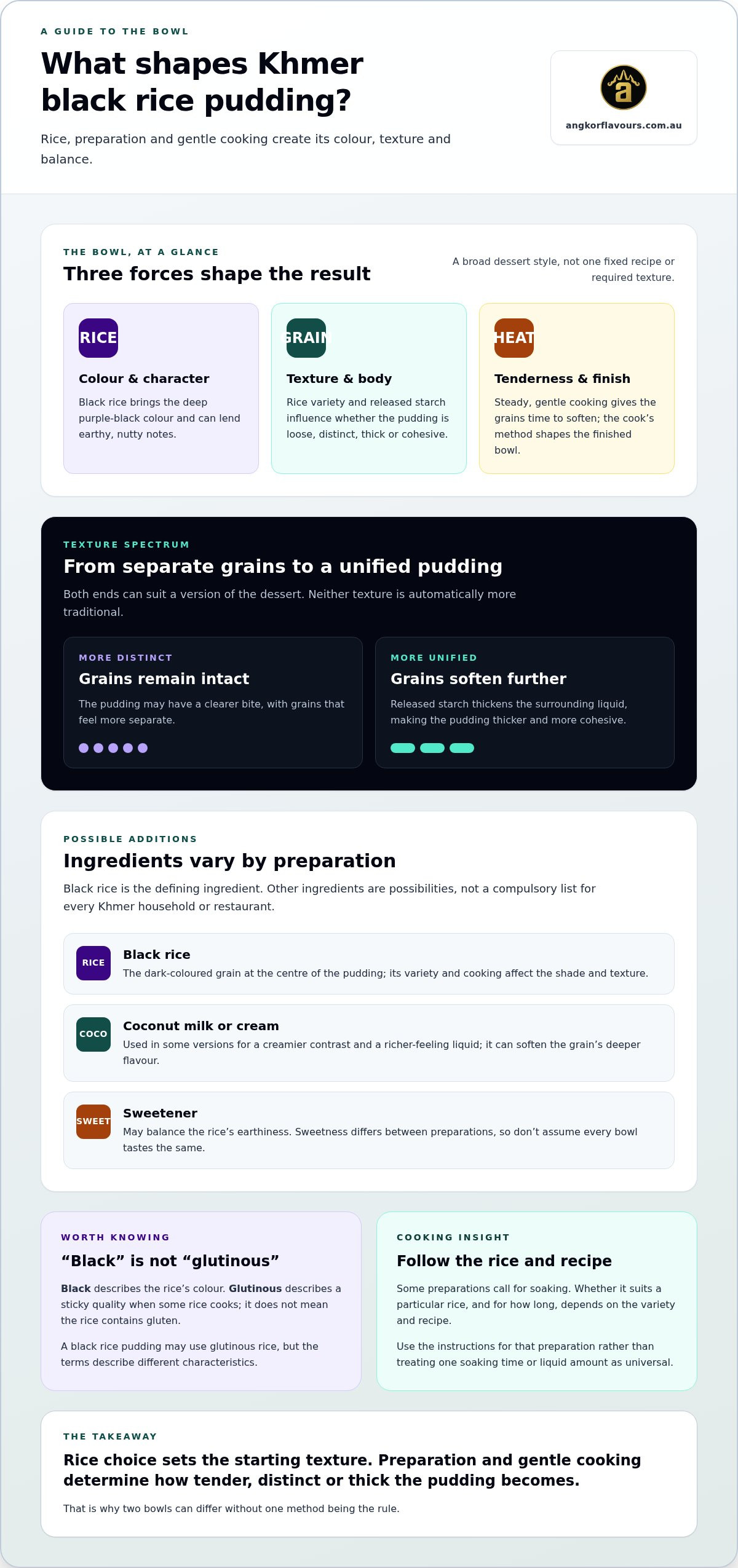
A bowl’s character begins with its rice, then develops as the grains soften and release some of their starch. That is why traditional black rice pudding is not defined by colour alone. The type of rice and the cooking method help determine whether the finished dessert feels loose and spoonable or thick and cohesive.
Which ingredients may appear in black rice pudding?
Black rice is the defining ingredient, lending the pudding its dark, inky-purple colour. Beyond that, recipes differ. Coconut milk or cream and a sweetener appear in some Southeast Asian black sticky-rice desserts, creating a creamy contrast to the grain’s earthy, nutty notes. This black sticky rice pudding recipe offers one regional example, not a template for every Khmer household or restaurant.
Treat familiar additions as possibilities rather than a compulsory ingredient list. Coconut can soften the grain’s deeper flavour and give the liquid a richer feel, while sweetener can balance the rice’s earthiness. Other preparations may use a different combination or let the rice remain the main impression. When cooking at home, follow a recipe for the specific style you want to make instead of combining ingredient lists from different regional dishes.
Why soaking and cooking technique can change the texture
Preparing rice before cooking can affect how readily water reaches the grain and how evenly it softens. Some rice preparations call for soaking, but whether it suits a particular black rice, and for how long, depends on the variety and recipe. Use the instructions for the rice and recipe you have, rather than treating one soaking time or liquid amount as universal.
During cooking, steady, gentle heat gives the grains time to become tender. Starch released from the rice thickens the surrounding liquid. If the grains remain intact, the pudding may have a clearer bite; if they soften further, it can become thicker and more unified. Neither texture is automatically more traditional. The desired result depends on the cook’s method and the style of pudding being made.
Rice choice sets the starting texture; preparation and gentle cooking determine how tender, distinct or thick the finished pudding becomes. This makes it easier to understand why two bowls can differ without treating one method as a rule. It also explains why colour and name alone do not tell you exactly how a pudding will feel to eat.
At ANGKOR Cambodian Flavours, Chef Neri’s Cambodian family heritage inspires a wider Khmer dining experience. In West Melbourne, you can explore ANGKOR’s Black Rice Pudding as part of a dine-in meal.
Traditional Black Rice Pudding: Variations, Texture and Common Misconceptions
An online recipe shows one cook’s version, not every household’s or restaurant’s. With traditional black rice pudding, black rice is the defining feature, but the variety, added ingredients and finished consistency can differ. Variation is part of how food is prepared across different kitchens and traditions.
Is there one single traditional recipe?
There is no single ingredient list that should be treated as the universal Khmer recipe. To understand a particular version, look at the details of that preparation: which rice is named, what sweetener is used and how the dish is served. A broad description can introduce the dessert, but it cannot establish every cook’s ingredients or method.
It also helps to distinguish Khmer black rice pudding from related desserts elsewhere in Southeast Asia. Indonesian bubur ketan hitam, for example, is made with black glutinous rice and is commonly described with palm sugar and coconut milk. Those details belong to that named dish; they do not automatically apply to every Khmer version.
How should readers understand different textures and sweetness?
Think of texture and sweetness as features of a particular preparation, not tests of authenticity. One pudding may have distinct grains, while another is softer and thicker. Sweetness may be gentle or more pronounced. A photograph or online recipe cannot establish one result as the standard for all versions.
The comparison below outlines broad characteristics of two related desserts. It is a guide to their differences, not a claim that every household follows the same formula.
| Version | Rice | Sweetness and texture | Serving details |
|---|---|---|---|
| Khmer black rice pudding | Black rice is central; the exact variety can’t be generalised here. | Sweetness and consistency depend on the preparation. | Don’t assume one serving style applies to every version. |
| Indonesian bubur ketan hitam | Black glutinous rice, as described for this related dish. | Palm sugar is commonly used; the cooked rice forms a soft porridge. | Often served with coconut milk, according to descriptions of this dish. |
“Glutinous” means sticky in texture; it does not mean every black rice dessert uses the same grain. Nor is the comparison a ranking. A softer pudding is not more traditional simply because it resembles a neighbouring dish. Each version makes sense on its own terms.
Do not infer dietary qualities from a dessert’s name or colour. Whether a particular bowl suits someone’s needs depends on its actual ingredients and preparation. Check the ingredient information for the specific version rather than applying a broad label to all black rice puddings.
How to Enjoy Black Rice Pudding and Notice Its Flavours
You do not need specialist knowledge to enjoy a first taste. Take a moment with the bowl, then let each spoonful tell you what stands out. Black rice pudding can be unfamiliar in colour and texture, but there is no single correct way to describe it. Notice whether you enjoy the rice’s character, the level of sweetness or the way the flavours linger.
A simple first-tasting guide for a new dessert
Begin with the appearance and aroma before tasting. The dark grains make a striking first impression, while aromas depend on the particular preparation. Then take a small spoonful and notice the rice and the surrounding pudding. This simple sequence can help you explore the bowl:
- Pause and notice. Look at the colour and texture. Bring the spoon close and take in the aroma without guessing which ingredients are present.
- Try the grains. Notice whether they feel distinct or soft, and how they compare with the smoother parts of the pudding, if there are any.
- Consider the sweetness. Is it gentle, pronounced or somewhere between? Notice how it balances the taste of the rice.
- Wait for the finish. After swallowing, reflect on what remains. You might describe it as mellow, earthy, sweet or simply comforting.
These are prompts, not a scorecard. You do not need to identify every ingredient or decide whether a texture is “right”. If you enjoy the first spoonful, take another and see whether you notice something different. Let the bowl in front of you guide your impressions, as recipes and serving styles vary.
How black rice pudding can complete a Khmer meal
A dessert can offer a gentle close to a meal, though Khmer dining does not need to follow one fixed sequence. At a shared table, savoury dishes and something sweet can each have their own moment. Moving from a savoury dish to pudding gives you a chance to slow down and notice a different set of flavours.
For a sense of the broader Khmer meal, ANGKOR Cambodian Flavours serves dishes such as traditional Fish Amok and Cambodian Beef Loc Lac. Their savoury character offers a different experience from dessert, without requiring a particular order or pairing. The restaurant’s Black Rice Pudding is another way to explore Cambodian food.
Enjoy it at your own pace, on its own or as part of a shared meal. To try the dessert in West Melbourne, visit ANGKOR Cambodian Flavours.
Where to Try Traditional Black Rice Pudding in West Melbourne
Curiosity about a dessert often becomes clearer over a shared meal. In West Melbourne, ANGKOR Cambodian Flavours serves Black Rice Pudding as one of its traditional Khmer desserts. It is a way to move from reading about the dish to tasting it in a Cambodian restaurant, without expecting every bowl to match one universal recipe.
A Khmer dessert at ANGKOR Cambodian Flavours
ANGKOR is a Cambodian restaurant led by Chef Neri, whose cooking is inspired by her family heritage. That connection informs the restaurant’s broader Khmer dining experience, including its traditional Black Rice Pudding. The dish is best enjoyed as the version served at ANGKOR, rather than as a claim to represent every Khmer family’s recipe.
Black Rice Pudding is served as part of dine-in lunch and dinner. If you are new to Cambodian desserts, you can include it in a meal and take time to notice its texture and flavour. You do not need to know the right words for every quality; start with what stands out to you.
The wider setting adds context. The dessert sits alongside other Cambodian dishes and the hospitality shaped by Chef Neri’s family heritage. It is one part of the restaurant’s Khmer dining experience, rather than an isolated recipe meant to represent every household. Its name gives you a starting point; tasting it adds details that a general description cannot convey.
Take the next step from curiosity to a shared meal
If you are in Melbourne and would like to explore Cambodian food, ANGKOR’s West Melbourne dining room offers a place to enjoy a dine-in meal. Come with questions or simply let the dishes introduce themselves. Black Rice Pudding is a natural point of interest for anyone curious about black rice desserts.
Bring a friend or enjoy the meal at your own pace. There is no need to treat dessert as a test of culinary knowledge. Notice its appearance, taste and texture in your own way, and let the experience add something personal to what you have learnt about Khmer food culture.
Explore ANGKOR Cambodian Flavours’ dine-in Cambodian menu in West Melbourne and make room for Black Rice Pudding as part of your visit. You’re warmly invited to enjoy this traditional Khmer dessert at the table.
Make Your Next Meal a Moment of Discovery
Let curiosity lead the way. The next time you sit down to a Khmer meal, leave a little room for a new taste and let the experience become your own. You do not need a special occasion or detailed knowledge of Cambodian food to enjoy something unfamiliar. A shared table is a welcoming place to begin.
At ANGKOR Cambodian Flavours, traditional black rice pudding is served as a Khmer dessert in the restaurant’s West Melbourne dining room. Chef Neri’s cooking is inspired by her family’s Cambodian heritage, bringing a personal connection to the wider dining experience without asking one dish to stand for every tradition.
Take your time, follow your own palate and enjoy discovering a dessert that is new to you. Come and enjoy ANGKOR’s Cambodian dining in West Melbourne, and let a shared meal open the door to more Khmer flavours.
Frequently Asked Questions
Is black rice the same as glutinous rice?
No. Black rice describes a dark-coloured grain, while glutinous rice describes a type of rice that becomes sticky when cooked. Some black rice is glutinous, but the terms are not interchangeable. If you are buying rice for pudding, check the packet for both the grain’s colour and whether it is labelled sticky or glutinous. This helps you choose a texture suited to the recipe you plan to follow.
Do you need to soak black rice before cooking pudding?
Not always. Soaking depends on the rice variety and recipe. Check the packet or a tested recipe for instructions, as different grains may soften at different rates. If the recipe calls for soaking, use the stated time rather than guessing. If it does not, avoid adding a soak automatically, as extra water and a changed starting texture can affect the result and cooking process.
Can black rice pudding be made with coconut milk?
Yes, some black rice pudding recipes use coconut milk, which adds a creamy quality and gentle coconut flavour. It is an option, not a requirement for every version. Follow the proportions in your recipe rather than substituting coconut milk for all the cooking liquid without guidance. For a particular bowl, use its ingredient information instead of assuming coconut is included.
Why is black rice pudding sometimes chewy?
Chewiness can come from the rice variety, how fully the grains have softened or the pudding’s consistency. Sticky rice naturally clings and may keep a more noticeable bite than a softer-cooked version. If you are making it at home, test a few grains as they cook. If they are still too firm, continue cooking according to your recipe and add liquid only as its instructions allow.
Can black rice pudding be served cold?
Yes, prepared pudding can be enjoyed cold if that suits the recipe and serving style. Chilling usually makes rice desserts firmer, so the texture may feel different from when freshly cooked. If you are making it specifically to serve cold, follow a recipe written for that purpose. At a restaurant, enjoy the dessert as it is presented rather than assuming every version is served chilled.
How should leftover black rice pudding be stored?
For homemade leftovers, transfer the pudding to a clean, covered container and refrigerate it promptly rather than leaving it out to cool for a long time. Use a shallow container so it cools more quickly, and follow current Australian food-safety advice for storage and reheating. Rice can become firmer in the fridge; when reheating, stir it well and make sure it’s steaming hot throughout before serving.


