

What makes a Khmer family recipe authentic: the ingredients, the method, or the memories gathered around it? Often, it’s all three, shaped over time by the people who cook and share it. Authentic khmer family recipes can seem distant when they’re presented as a list of unfamiliar ingredients, or as though every household follows one fixed version. In reality, family cooking is personal, with traditions that can vary from one kitchen to another.
In Khmer homes, food can carry the rhythms of everyday hospitality: a familiar aroma, a meal made for sharing, a flavour that brings someone to mind. Ingredients such as prahok, a fermented fish paste, and kroeung, a fragrant paste made with fresh aromatics, offer a starting point for recognising the character of the cuisine. You don’t need expert knowledge to notice how aroma, seasoning and texture work together.
Here, discover how heritage, memory and the table come together in Khmer cooking, and why family recipes can vary while still holding meaning. At ANGKOR Cambodian Flavours in West Melbourne, Chef Neri’s cooking is inspired by her Cambodian family heritage. That connection is reflected in My Grandmother’s Dish, a signature family recipe. Come with curiosity, and let the stories and flavours make room for you.
Key Takeaways
- Authentic khmer family recipes reflect household traditions and shared memories, not one fixed version every family must follow.
- Aroma, seasoning and texture work together to shape a dish’s character.
- Written measurements and sensory cues can both help explain why recipes differ between households.
- Explore a dish thoughtfully: learn its name and context, follow a reliable recipe, then note what you observe as you taste.
- At ANGKOR in West Melbourne, family heritage meets the table through dishes including My Grandmother’s Dish, a signature family recipe.
What makes authentic Khmer family recipes feel like home?
An authentic Khmer family recipe is connected to the ways a household cooks, remembers and shares food. Its meaning may sit in a familiar taste, the person who taught a particular step, or a meal that brings relatives together. It’s more than a set of instructions: a family recipe can carry practical knowledge and personal memory to the table.
That doesn’t mean there’s one official version every Khmer family must make. Authenticity isn’t a test of whether a dish matches a single written formula. Household preferences, experience and the ingredients available can all shape how it’s prepared and enjoyed. The phrase authentic khmer family recipes describes traditions with many voices, not one unchanging rulebook.
For broader context, the overview of Cambodian cuisine can help readers explore its food culture and mealtime customs. Here, the focus is on how cooking knowledge and meaning travel between people, and how to approach those traditions with care.
How do family recipes carry memory across generations?
Sometimes, a cooking lesson is taught step by step. At other times, someone learns by watching a relative prepare a dish, noticing how a mixture looks or smells, then trying it at another family meal. Repetition builds familiarity. A warm pot, a changing aroma and a texture recognised by touch can become cues as useful as written measures.
Those cues hold culinary knowledge, but a dish can also bring to mind the people and occasions around it. A certain flavour might recall a shared meal or the care of someone who cooked it. Memories differ from person to person, even within one family. That’s part of what makes food personal, rather than a record with one story attached.
Does an authentic Khmer recipe have only one version?
No single variation represents every Khmer household. One cook may prefer a more pronounced seasoning; another may adjust a dish to suit the ingredients on hand or the tastes of those at the table. Such changes can be part of everyday cooking, not evidence that one version is automatically more genuine.
Imagine two relatives preparing the same dish for a shared meal. One may measure by feel, while the other follows a note they’ve kept. Their results might differ slightly in aroma or texture, yet each can reflect a meaningful household practice. Respectful adaptation recognises that context, rather than claiming one family’s preference speaks for all.
At ANGKOR Cambodian Flavours in West Melbourne, Chef Neri’s cooking is inspired by her Cambodian family heritage. My Grandmother’s Dish is served as a signature family recipe, not as a template for every Khmer kitchen. As you explore the traditions behind family food, leave room for both the flavours and the stories to be distinct.
The flavour foundations that give Khmer family cooking its character
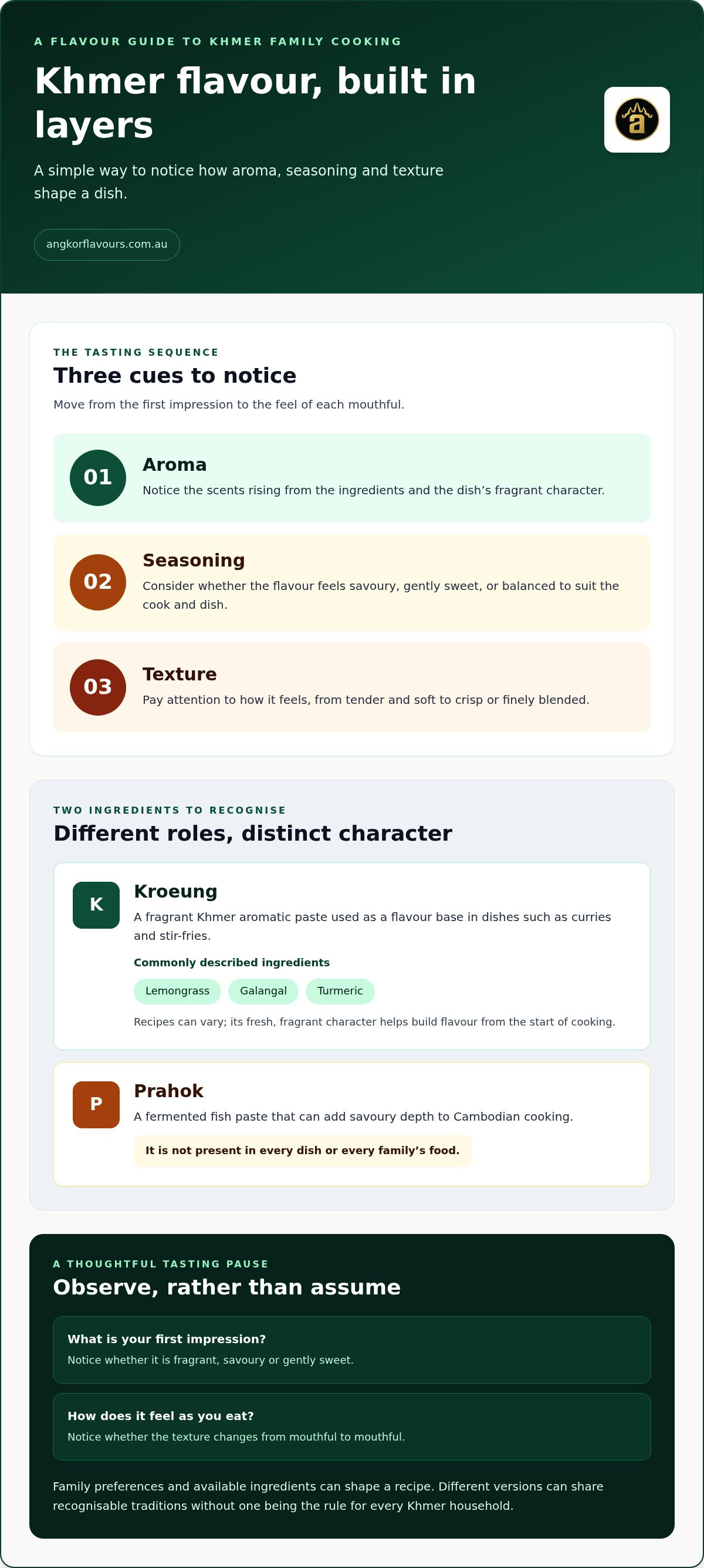
Khmer flavours are easier to approach when you think in layers: aroma first, then seasoning, then the feel of each mouthful. A fragrant base can meet savoury depth or gentle sweetness, while a fresh or tender texture adds another dimension. There isn’t one formula for balancing these elements. Family taste and the dish itself both matter.
What is kroeung in Khmer cooking?
Kroeung is a Khmer aromatic paste used as a flavour base in dishes such as curries and stir-fries. Commonly described ingredients include lemongrass, galangal and turmeric, though recipes can vary. Its fresh, fragrant character helps build flavour from the start of cooking.
Another term readers may encounter is prahok, a fermented fish paste used in Cambodian cooking for savoury depth. It’s a distinctive ingredient, but it isn’t present in every dish or every family’s food. The context of the recipe matters. When you encounter an unfamiliar flavour, notice its aroma and how it sits alongside the other elements.
This compact glossary separates general meanings from details that can change between households:
- Kroeung: An aromatic paste used as a cooking base; its precise recipe can vary.
- Prahok: Fermented fish paste that can add savoury depth; it isn’t universal to every dish.
- Aroma: The scents that rise from ingredients and signal a dish’s fragrant character.
- Texture: How a dish feels, from tender and soft to crisp or finely blended.
How do ingredients and seasoning vary between households?
A cook may adjust seasoning to suit family preferences or work with ingredients available at the time. That can shift the balance without making one version the measure for all Khmer cooking. Rather than guessing why a recipe differs, start with what’s in front of you: notice the aroma, taste carefully and consider how seasoning and texture come together.
For a simple tasting exercise, pause between mouthfuls. Is the first impression fragrant, savoury or gently sweet? Does the texture change as you eat? These observations make culinary terms less abstract and leave room for your own response, rather than telling you what you ought to taste. Authentic khmer family recipes can share recognisable traditions while reflecting different cooks and tables.
At ANGKOR Cambodian Flavours, Chef Neri’s cooking is inspired by her Cambodian family heritage. My Grandmother’s Dish is served as a signature family recipe. To explore Cambodian cooking around a shared table in West Melbourne, visit ANGKOR Cambodian Flavours.
Family recipes and written recipes: what changes between households?
A written recipe makes instructions easier to revisit and share, but it may not capture everything a cook learns by watching, tasting or cooking alongside someone familiar with the dish. These forms of knowledge can complement each other: a page records the details, while experience helps explain what the words look and feel like in practice.
Neither format is automatically more authentic. Some family recipes are carefully written down; others are passed on through conversation and repeated cooking. Households also make choices according to their own preferences. The comparison below shows what each approach can preserve, rather than setting a rule for how Khmer families cook.
Why do family cooks sometimes measure by feel?
For a cook who knows a dish well, cues such as consistency or aroma can be easier to recognise than a number on a page. That doesn’t mean every Khmer cook measures informally; methods differ. If you’re learning, note the written quantities, then record what you see, smell and taste at each step. Those observations can make the instructions clearer next time.
How can a written recipe leave room for family style?
Separate the instructions a recipe gives from the choices a cook makes around them. For example, record a stated step as part of the method, then note a family member’s preference separately rather than presenting it as universal. Write down who shared the recipe, when you cooked it together and what made the dish meaningful to them. A clear record preserves both directions and context.
As you learn, keep useful notes: what the cook described, what you observed and which details are your own impressions. If you make a change, record it as an adaptation rather than rewriting the original account. That keeps the source visible while allowing your version to develop. Adaptation alone doesn’t make a family recipe inauthentic; care, context and honest description matter too.
Authentic khmer family recipes can be written down without being reduced to measurements alone. A recipe may preserve a household’s way of doing things, while the person cooking still brings attention and judgement to the table. Let the notes guide you, and leave room for knowledge that grows with practice.
How to explore a Khmer family recipe with care and confidence
Begin with curiosity, not the pressure to get everything exactly right. A thoughtful approach helps you understand a dish’s name and context, follow a reliable recipe, and notice how its flavours and textures come together.
- Learn the dish’s name. Use the name supplied by the cook or a reliable source, and take care with unfamiliar words.
- Understand its context. Find out what the dish means to the person sharing it, and whether their account describes a personal or household tradition.
- Follow a verified recipe. Start with clear instructions from a credible Cambodian cook, then pay attention as you prepare and taste the dish.
Where can a beginner start with Khmer cooking?
Choose one clearly written, tested recipe from a Cambodian cook, with steps you can follow and terms explained as they arise. You don’t need to learn every ingredient name at once. Begin with one dish and one flavour or technique to notice. As you cook, taste attentively and jot down what you observe, such as a familiar aroma or a texture that changes. Your notes describe your experience, not a single correct result.
If a recipe introduces a Khmer term, look for its meaning in the recipe’s own context before moving on. A short explanation alongside the first mention is easier to use than a long glossary before you begin. Let the instructions guide the process, and avoid substituting ingredients or changing steps based on guesswork. If a detail is unclear, return to the recipe’s source rather than assuming all versions work the same way.
How can readers preserve a family recipe respectfully?
Write down the contributor’s name and the story they’re comfortable sharing. Ask how they describe the dish and note any variations as preferences, not mistakes. If you plan to publish someone else’s recipe or personal story, ask their permission first. A careful record can preserve the cook’s words and perspective, while making clear which details are theirs and which observations are yours.
For your own cooking notes, keep the source instructions distinct from what you change or notice. Record when you made it, what the recipe said and what you learned from the result. That makes the notes useful without quietly turning one household’s approach into a claim about every family. Authentic khmer family recipes are best explored with respect for the people and context behind them, alongside an open mind at the table.
Follow the recipe’s food-safety instructions, and use current Australian food-safety guidance for any questions about preparing or storing food. Don’t guess at temperatures or storage times. If you’d rather experience Cambodian cooking around a shared table, visit ANGKOR Cambodian Flavours in West Melbourne.
Experience Khmer family heritage at ANGKOR in West Melbourne
Food can welcome you into a culture through more than flavour alone. It can invite questions, encourage conversation and make a shared meal feel meaningful. At ANGKOR Cambodian Flavours in West Melbourne, Chef Neri’s cooking is inspired by her Cambodian family heritage. That personal context informs the restaurant’s hospitality, while each dish has its own place at the table.
What does a family-inspired dish bring to the table?
A family recipe can connect cooking with memory, care and the pleasure of sharing food. Its meaning may be personal to the people who know it, and it doesn’t need an invented origin story to matter. At ANGKOR, My Grandmother’s Dish is a signature family recipe. Its name signals a connection to family cooking, while the dish can be enjoyed without assuming it represents every Khmer household.
This is one way to approach authentic khmer family recipes with respect: look for the relationship behind the food, but don’t fill in details that haven’t been shared. A dish can carry heritage through the cook’s connection to it and the welcome extended to those gathered around the meal. The stories remain individual, not a template for an entire culture.
Which other Khmer dishes can readers discover at ANGKOR?
ANGKOR’s menu also includes Fish Amok in Melbourne and Black Rice Pudding. These dishes offer another way to encounter Cambodian food, whether you’re exploring a familiar favourite or meeting something new. Let each one be its own experience, rather than expecting it to explain every family’s cooking.
If you’d like a wider introduction to the local dining scene, the guide to authentic Khmer food in Melbourne offers more context around heritage, flavour and eating out. It can sit alongside this exploration of family recipes, helping you notice how cultural tradition is shared through food while leaving room for each cook’s own story.
At ANGKOR, family heritage meets the warmth of a shared dining experience in West Melbourne. Bring your curiosity, take your time with the flavours, and explore Khmer family heritage at ANGKOR.
Let the flavours lead you to the table
Let your next step be a simple one: bring the curiosity you’ve gathered here to a shared meal. You don’t need to recognise every ingredient or know the story behind every dish before you sit down. Listen, taste and make space for the details that speak to you. That’s one way authentic khmer family recipes can open a conversation, not just satisfy an appetite.
At ANGKOR, independently operated by Chef Neri and inspired by her Cambodian family heritage, that welcome takes shape through Cambodian cuisine in West Melbourne. My Grandmother’s Dish is a signature family recipe, shared as part of the dining experience without needing to stand for every family’s tradition.
Come and discover Khmer family-inspired cooking at ANGKOR. Take a seat, follow your curiosity and enjoy the warmth of a meal shared around the table.
Frequently Asked Questions
What makes a Khmer family recipe authentic?
Authenticity comes from an honest connection to Khmer cooking and the people, practices or sources behind a dish, not from a claim that there’s only one correct version. If you’re trying a recipe, look for a Cambodian cook’s explanation of its name, context and method. Keep track of who shared it and what they said. That helps distinguish a documented tradition from assumptions added by someone else.
Are all Khmer family recipes made the same way?
No. A household may adjust a dish according to its preferences, cooking experience or the ingredients it has to hand. If you’re comparing two versions, note what the cooks say about their choices rather than treating differences as mistakes. Record which details both recipes share and which are specific to each cook. That comparison can reveal variation without suggesting either version represents every Khmer family.
What is kroeung, and how is it used in Khmer cooking?
Kroeung is an aromatic paste used as a flavour base in Khmer cooking, including in some curries and stir-fries. Recipes differ, so follow the ingredient list and method of the particular recipe rather than assuming every kroeung is identical. If you’re new to the term, notice how the paste contributes fragrance as a dish cooks. A reliable recipe can explain its role in that specific dish.
Can I make Khmer family recipes with ingredients available in Australia?
Often, you can begin with ingredients you can source locally, but whether a substitution works depends on the recipe. Check the instructions for any notes about alternatives before swapping an unfamiliar ingredient. Specialty grocers in Australia may stock ingredients not found in a usual supermarket, though availability varies by area. If a recipe gives no substitution advice, keep the original ingredient rather than assuming a similar-looking item will taste or behave the same.
How can I preserve a family recipe for future generations?
Record the recipe in a format your family can revisit, such as a notebook or shared digital document. Include the contributor’s name, the date you recorded it and any wording they use to describe the dish. If you cook together, add notes about what you observed, clearly separated from the contributor’s instructions. Ask permission before sharing their recipe or personal story beyond the family, and let them decide what remains private.
What is the difference between Khmer food and Cambodian food?
“Khmer” usually refers to the country’s majority ethnic group, language and associated culture, while “Cambodian” refers more broadly to Cambodia and its people. In everyday food writing, the terms often overlap: Khmer cuisine commonly describes Cambodia’s culinary traditions. Cambodia is also home to diverse communities, so “Cambodian food” can be a broader label. Use the term that best fits the context and the source’s own description.
Where can I try Khmer family-inspired food in West Melbourne?
ANGKOR Cambodian Flavours serves Cambodian cuisine in West Melbourne. Its offerings include My Grandmother’s Dish, a signature family recipe, alongside Fish Amok, Beef Loc Lac and Black Rice Pudding. The restaurant is independently operated by Chef Neri, whose cooking is inspired by her Cambodian family heritage. It’s a welcoming way to experience Khmer family-inspired cooking around a shared table, even if you’re just beginning to explore the cuisine.


