

What if the best way to explore Southeast Asian food in Melbourne is to follow its regional traditions, rather than rely on a broad label? Choosing a traditional southeast asian restaurant melbourne can feel daunting: familiar-sounding menus may sit alongside dish names you’ve never tried, with little context to help you decide.
Cambodian, Thai, Vietnamese, Malaysian and other Southeast Asian cuisines each have their own histories, flavours and ways of gathering around a meal. Some dishes are bright and fragrant; others are gently warming or slow and rich. Knowing a little about those differences can help you choose a place for a quick meal, a shared feast or a first taste of something new.
This guide explores Melbourne’s varied dining traditions, with practical context for what sets them apart and where to begin when a menu feels unfamiliar. Along the way, you’ll meet ANGKOR Cambodian Flavours in West Melbourne, an independently operated restaurant shaped by Chef Neri’s Cambodian family heritage. Its Khmer dishes, including Fish Amok and Beef Loc Lac, and its Black Rice Pudding offer a welcoming starting point for discovering one distinctive part of Southeast Asia’s food story.
Key Takeaways
- Look beyond the broad “Southeast Asian” label to explore the distinct identities of Cambodian, Thai, Vietnamese, Malaysian and Indonesian food.
- Notice how regional ingredients, aromatics, seasoning and textures help shape a dish’s character.
- Compare ingredient-led discovery with contemporary bar-and-dining to find a traditional southeast asian restaurant melbourne experience that suits your curiosity.
- Choose a regional interest and occasion first, then use menu descriptions to feel more confident ordering unfamiliar dishes.
- Explore ANGKOR in West Melbourne for Cambodian dining, or consider its Event Feasts when gathering with a group.
What does traditional Southeast Asian dining in Melbourne include?
Traditional Southeast Asian dining in Melbourne brings together distinct regional food traditions, not one uniform cuisine. Cambodian, Thai, Vietnamese, Malaysian and Indonesian cooking each have their own histories, culinary identities and ways of expressing flavour. A restaurant may stay close to established traditions, interpret them for a local audience or bring heritage into a contemporary setting.
That distinction matters when you’re choosing where to eat. “Asian food” can be useful shorthand, but it doesn’t tell you much about a menu’s origins or character. A Cambodian restaurant offers a particular cultural perspective; it isn’t a summary of Thai, Vietnamese, Malaysian or Indonesian food. Even within one country’s cuisine, regional and family traditions can differ.
Melbourne’s dining scene reflects communities with varied cultural roots, alongside restaurants that present those traditions in different ways. Some centre a specific regional identity, while others take a contemporary approach to dining and hospitality. The setting may change, but the cultural roots still matter. Looking for a restaurant’s regional focus gives you a more useful starting point than choosing by a broad label alone, particularly when exploring West Melbourne’s local dining options.
Why Melbourne’s Southeast Asian food scene is varied
Each tradition has its own culinary vocabulary, shaped by history, local influences and practices passed between generations. Cambodian, Thai, Vietnamese, Malaysian and Indonesian menus shouldn’t be treated as interchangeable, even when they share ingredients or dining influences. For a wider overview of these regional differences, Southeast Asian cuisine on Wikipedia offers useful background. Think of the region as a collection of food cultures, not a single menu style.
That variety also means no one venue or dish can represent an entire country. A restaurant’s own heritage and point of view are more meaningful guides. In Melbourne, a traditional southeast asian restaurant melbourne diners choose may preserve familiar dishes, present a particular family’s food traditions or pair cultural roots with a contemporary dining format. Each approach can offer a different way into the region’s food.
What diners can expect from a traditional dining experience
Regional context can make an unfamiliar menu easier to read. Notice where a restaurant’s food comes from, how it describes its dishes and whether it invites you to share. Some menus stay close to familiar traditions; others interpret them for local diners. Neither approach tells the whole story of a cuisine, but both help you understand the restaurant’s particular perspective.
Shared dishes and generous hospitality are part of some dining experiences, though customs vary between cultures, households and venues. You don’t need to know every dish name before you arrive. Start with the regional tradition that interests you, read the menu at your own pace and choose what sounds appealing. A welcoming table is a good place to begin.
How ingredients and cooking traditions shape Southeast Asian flavours
Aroma reaches the table before the first bite. Herbs, spices, seasonings and textures all help give a dish its character, but their combinations and meanings vary between regional traditions. An ingredient is a clue, not a shortcut to understanding an entire cuisine. The same is true of cooking methods: context matters, and no single flavour profile or technique represents all of Southeast Asia.
For diners, noticing these details can make a menu choice more rewarding. A fragrant note, a sharp contrast or a particular texture may prompt a question about a dish’s origins or how a restaurant interprets it. The Southeast Asian Food and Culture resource from NIU offers broader context for the cultural connections between food, ingredients and eating traditions.
Ingredients as a doorway into regional food
Miss Mi’s ingredient feature highlights pandan and Kampot pepper as examples of ingredients that can invite closer attention. Pandan is known for a sweet, floral fragrance, while Kampot pepper is associated with Cambodia’s Kampot region. These are useful starting points for curiosity, not a checklist for identifying every dish or defining every Southeast Asian cuisine.
Herbs and aromatics can lend freshness or fragrance; seasoning can bring contrast, depth or brightness. Texture matters, too. A crisp element beside something tender creates a different impression from a smooth, soft dish. The balance depends on the food tradition and the cook’s choices, so read each menu on its own terms rather than expecting the same ingredients or flavours everywhere.
Understanding the story behind an ingredient can turn a meal from a menu choice into a more meaningful encounter with a region’s food culture. That’s a helpful approach to a traditional southeast asian restaurant melbourne experience: look for context around a dish instead of relying on one familiar ingredient to tell the whole story.
Tradition, interpretation and the Melbourne dining table
Tradition doesn’t require every restaurant to present a meal in exactly the same way. A venue can honour culinary roots while choosing a contemporary setting, presentation or style of service. Those choices shape the experience, but they don’t erase the importance of the food’s cultural background. The useful question is what perspective the restaurant is sharing, not whether its dining room looks traditional.
Miss Mi’s ingredient-led approach gives diners one way to focus on distinctive ingredients. JUNI, by contrast, is positioned as a contemporary Southeast Asian bar and dining venue. These are different approaches, not competing definitions of tradition. Neither is a stand-in for a whole region or a guide to what every restaurant serves.
At ANGKOR in West Melbourne, Chef Neri’s Cambodian family heritage informs the restaurant’s identity. Its Khmer dishes offer a specific point of connection to Cambodian dining, without claiming to represent every Southeast Asian tradition. To explore that perspective, discover Cambodian dishes at ANGKOR as one grounded place to begin.
Three ways to explore traditional Southeast Asian dining in Melbourne
There’s no single template for a Southeast Asian meal in Melbourne. One table might invite you to notice how ingredients shape a dish; another might pair dining with a contemporary bar setting; a third may offer a closer connection to a specific family heritage. These are different ways to explore, not a ranking of the city’s restaurants or a measure of which experience is more authentic.
If you’re searching for a traditional southeast asian restaurant melbourne, first consider the kind of discovery you want. Are you curious about particular ingredients, drawn to a modern bar-and-dining atmosphere or hoping to encounter Cambodian food through a family-rooted perspective? Each route offers a different point of entry.
Ingredient-led and contemporary Southeast Asian dining
Miss Mi’s ingredient feature draws attention to ingredients such as pandan and Kampot pepper, offering an ingredient-led way to approach Southeast Asian food. It’s a useful lens if you enjoy following a flavour or ingredient into its culinary context, rather than treating a dish name as the whole story.
JUNI offers a different kind of setting as a Southeast Asian bar-and-dining venue. Its contemporary format can sit alongside regional inspiration; a modern atmosphere doesn’t automatically mean a restaurant has set cultural roots aside. These examples aren’t interchangeable, and neither represents every food tradition across the region.
Cambodian heritage and a shared table in West Melbourne
ANGKOR in West Melbourne brings the focus to Cambodian dining. Independently operated by Chef Neri, the restaurant’s identity is inspired by her Cambodian family heritage. Its dine-in Khmer dishes include Fish Amok, Beef Loc Lac and My Grandmother’s Dish. They offer an introduction to the restaurant’s cultural perspective, not a stand-in for all Southeast Asian cooking.
For a gathering, ANGKOR also offers curated Event Feasts for groups. Sharing a meal is another way to explore the restaurant’s food and heritage, without needing detailed knowledge of every dish. If you’re exploring the neighbourhood, browse this guide to hidden gem restaurants in West Melbourne.
| Dining approach | Useful context | May suit diners who… |
|---|---|---|
| Ingredient-led at Miss Mi | Miss Mi’s ingredient feature spotlights individual flavour cues. | Like exploring the story behind ingredients. |
| Contemporary bar-and-dining at JUNI | JUNI combines a Southeast Asian dining identity with a bar setting. | Want a modern venue for food and drinks. |
| Cambodian dining at ANGKOR | Chef Neri’s family heritage informs its Khmer dining identity; Event Feasts are available for groups. | Are curious about Cambodian food or planning a group meal. |
Use the table as a starting point, then follow the experience that suits your curiosity and occasion. Each venue offers its own perspective, which is part of the pleasure of exploring Melbourne’s regional dining scene.
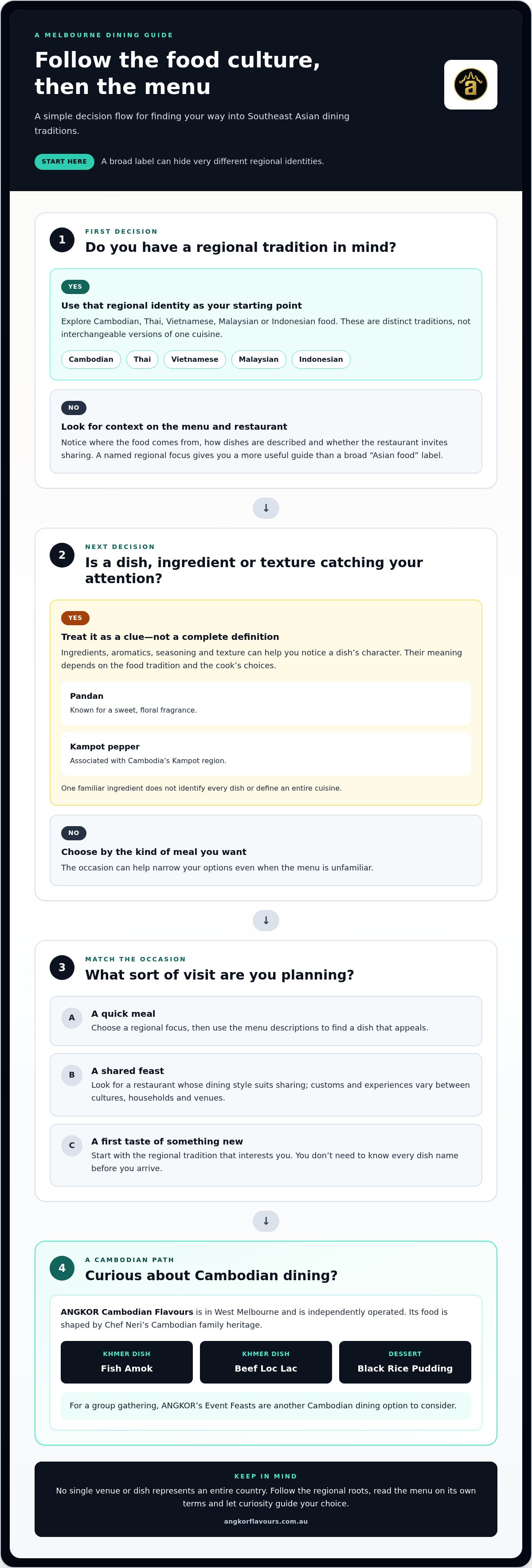
How to choose a Melbourne Southeast Asian dining experience for your first visit
A first visit doesn’t need to feel like a test. Start with what catches your interest, then choose a setting that suits the occasion. A little context can make an unfamiliar menu easier to approach, but you don’t need specialist knowledge to enjoy a meal. Curiosity is plenty.
Use this simple sequence to find a dining experience that feels right:
- Choose a regional curiosity. Is there a particular food tradition, dish name or ingredient you’d like to learn about? Let that interest guide your starting point.
- Think about the occasion. A relaxed meal, an ingredient-led discovery and a group gathering can call for different dining styles. Decide what kind of experience you want to share.
- Explore the menu context. Read the descriptions and venue information at your own pace. Look for clues about a dish’s regional background or the restaurant’s cultural perspective.
Match the experience to your occasion
Picture the meal you’re hoping to have. For a quiet dinner, you might prefer a setting where you can take your time with the menu. If you’re keen to follow a flavour or ingredient, an ingredient-led approach may suit. For a gathering, shared dining or an Event Feast can bring the table together. These are different options, not a ranking of venues.
Venue pages can help you understand a restaurant’s style before you arrive. Look for details about the dining format, the food’s regional roots and options for groups to get a clearer sense of what to expect. At ANGKOR in West Melbourne, Chef Neri’s Cambodian family heritage informs the restaurant’s identity, and curated Event Feasts are available for group bookings.
Make unfamiliar menus easier to approach
Choose one dish or ingredient that genuinely interests you, then read its description. You could begin with a Khmer dish, a flavour you recognise or a name you’re simply curious about. Take your time. You don’t need to understand every item on the menu before deciding what sounds inviting.
For a focused introduction to Khmer food, explore traditional Black Rice Pudding. Learning about one dish can offer a starting point, rather than a definition of an entire cuisine. Let the menu and your appetite lead the way.
If a Cambodian dining experience feels like the right fit, discover Khmer dining at ANGKOR in West Melbourne. Come with an open mind, choose what draws your attention and enjoy finding something new at the table.
Discover Cambodian dining at ANGKOR in West Melbourne
Among Melbourne’s many Southeast Asian dining experiences, ANGKOR offers a distinct Cambodian perspective. It isn’t a stand-in for the region’s many cuisines. It’s an independently operated restaurant in West Melbourne, where Chef Neri’s Cambodian family heritage informs its identity and dine-in Khmer menu. For diners curious about Cambodian food in particular, that perspective offers a welcoming place to begin.
A family-rooted Khmer menu in West Melbourne
Family heritage can give a restaurant’s menu a personal thread, connecting dishes to the people and traditions that shape the kitchen. At ANGKOR, Chef Neri’s Cambodian background is central to that story. The restaurant gives diners an opportunity to explore Khmer dishes in a setting grounded in one family’s heritage, rather than asking one menu to represent every Southeast Asian cuisine.
That context can help first-time diners approach unfamiliar names with interest instead of hesitation. The menu includes Fish Amok, Beef Loc Lac, My Grandmother’s Dish and Black Rice Pudding. Each is an invitation to explore a particular part of ANGKOR’s Cambodian dining experience. You don’t need prior knowledge of Khmer food to start; choose a dish that catches your attention and take the time to enjoy the meal.
For a closer look at one of the restaurant’s named dishes, read about Fish Amok in Melbourne. A dish-focused introduction can offer useful context before a visit, while the wider menu gives you room to follow your appetite and curiosity.
From a first meal to a shared Event Feast
A first visit might be a chance to try one Khmer dish or gather around the table with others. ANGKOR’s signature dishes include Fish Amok, Beef Loc Lac, My Grandmother’s Dish and Black Rice Pudding. Their names make a practical starting point for exploring the menu, without needing to know every detail in advance. Let the restaurant’s Cambodian identity guide your curiosity, while remembering that one venue reflects its own heritage and perspective.
For group bookings, celebrations and other gatherings, ANGKOR offers curated Event Feasts. Sharing a meal gives a group a chance to explore dishes together and make the occasion feel centred on the table. The experience remains rooted in Cambodian dining, rather than a broad regional assortment.
If you’re looking for a traditional southeast asian restaurant melbourne experience with a specifically Cambodian identity, ANGKOR offers a place to start, grounded in family heritage. Come for a dine-in meal, explore the Khmer menu at your own pace or gather around an Event Feast. Explore Cambodian dining at ANGKOR.
Let your next meal open a new door
Choosing a traditional southeast asian restaurant melbourne diners will remember doesn’t require knowing every dish in advance. Let one curiosity lead: a regional tradition, a name on the menu or the pleasure of gathering around a shared table. Each meal can be a first step, with more flavours and stories to discover next time.
For a Cambodian perspective, ANGKOR offers a personal connection to Khmer dining. Independently operated by Chef Neri and inspired by her Cambodian family heritage, it brings that story to the table through dine-in dishes and curated Event Feasts for group gatherings. It’s a chance to enjoy a meal while connecting with one distinct culinary tradition, rather than treating Southeast Asia as a single cuisine.
Bring a friend, make space for a dish you haven’t tried and let the experience unfold at its own pace. Come and explore Cambodian flavours at ANGKOR. Your next favourite meal may begin with simple curiosity.
Frequently Asked Questions
Is Southeast Asian cuisine the same as Asian cuisine?
No. Asian cuisine is a broad term covering food traditions from a vast continent, while Southeast Asian cuisine refers to traditions from a particular part of Asia. If you’re searching for a traditional southeast asian restaurant melbourne, look for the region or cultural tradition named by the venue rather than assuming a general “Asian” label tells you what its food represents. That distinction can make choosing a meal easier.
Is Cambodian food part of Southeast Asian cuisine?
Yes. Cambodian food is one of the distinct traditions within Southeast Asian cuisine. It has its own cultural and culinary context, so it shouldn’t be treated as interchangeable with Thai, Vietnamese, Malaysian or Indonesian food. A Cambodian restaurant can offer a focused introduction to one tradition, rather than a broad overview of the whole region. Menu descriptions can help you understand the perspective behind the dishes.
What does Khmer mean in Cambodian cuisine?
Khmer refers to the people, language and cultural identity associated with Cambodia, and the term is also used to describe Cambodian food traditions. You may see “Khmer cuisine” used to identify a restaurant’s culinary focus or the cultural roots of its dishes. It’s a useful word to recognise on a menu, but it doesn’t mean every Cambodian family or restaurant cooks in exactly the same way.
Is Southeast Asian food always spicy?
No. Southeast Asian food isn’t always hot with chilli, and spice levels vary between dishes and cooking traditions. “Spicy” can also mean different things to different diners: a dish might be fragrant, peppery or sharply seasoned without necessarily having strong chilli heat. If heat is a concern, use the menu description as your guide and choose a dish that sounds comfortable. There’s more to flavour than chilli alone.
Can I enjoy Cambodian food if I have never tried it before?
Absolutely. No background knowledge is needed to enjoy a new meal. Start with one dish that sounds appealing, read its description and let that be enough of a guide for your first visit. You might choose a main or finish with Black Rice Pudding if dessert is what catches your eye. Trying Cambodian food can be an enjoyable way to discover a new culinary tradition at your own pace.
How are traditional and contemporary Southeast Asian restaurant menus different?
The difference often lies in how a restaurant presents its food and dining experience, not in a simple divide between old and new. A menu might centre established regional dishes, while a contemporary venue may bring regional inspiration into a modern setting or style of service. These approaches can coexist, and neither label alone tells you everything about a restaurant’s cultural perspective. Read the menu and venue description for a clearer sense of its focus.
Can ANGKOR host a group meal in West Melbourne?
Yes. ANGKOR Cambodian Flavours in West Melbourne offers curated Event Feasts for group bookings, celebrations and gatherings. They provide a Cambodian dining option for a group looking to share a meal. The restaurant’s identity is distinctively Cambodian, so it’s a way to bring one regional food tradition to the table rather than treating Southeast Asian cuisine as a single style.


