

What makes a meal feel like a welcome into someone’s family heritage? If you’re searching for authentic khmer food melbourne, unfamiliar dish names and ingredients can make choosing feel daunting. Khmer cuisine offers an inviting way in, with fragrant aromatics, fresh herbs, savoury depth and warmth that doesn’t rely on overwhelming heat.
At ANGKOR Cambodian Flavours in West Melbourne, Chef Neri’s Cambodian heritage and family-inspired cooking bring that story to the table. Discover what gives Khmer food its character, how signature dishes such as Fish Amok and Beef Loc Lac make appealing first tastes, and how a family recipe can carry memories as well as flavour.
This guide explores the traditions behind the cuisine and the pleasure of sharing a meal. From My Grandmother’s Dish to communal Event Feasts, ANGKOR offers a locally rooted dining experience shaped by heritage, hospitality and the comforts of gathering around the table.
Key Takeaways
- Understand Khmer food as the varied cuisine and food traditions of Cambodia, rather than a single signature dish.
- Discover how aromatic pastes such as kroeung, fresh herbs and measured seasoning help shape a Khmer meal.
- Find a welcoming first taste among ANGKOR’s signature dishes, including Fish Amok and Beef Loc Lac.
- Learn what to look for in authentic khmer food melbourne: a clear culinary story, specific dishes and thoughtful explanations.
- See how ANGKOR’s independently owned West Melbourne venue brings Chef Neri’s Cambodian family heritage to the table.
Authentic Khmer food in Melbourne: what makes the cuisine distinctive?
Warm rice, fragrant herbs and dishes made for sharing: Khmer food invites you to slow down and notice the care in each recipe. For Melbourne diners, a little context can turn an unfamiliar menu into a more meaningful local dining experience. You don’t need to know every dish name before you sit down. Start with the ingredients and the story behind the cooking.
Khmer food is the cuisine and food traditions of Cambodia, shaped by the country’s ingredients, history and the ways people cook and eat. It includes everyday meals as well as dishes prepared for family gatherings and special occasions. No single recipe represents it all. Ingredients, flavours and customs vary between households and communities, and family recipes carry their own stories.
That variety matters when looking for authentic khmer food melbourne. Rather than expecting every Cambodian restaurant to serve the same menu, look for a clear connection to Khmer cooking and a sense of the people and traditions behind the food. An approachable explanation can help you understand what you’re ordering without making the meal feel like a lesson.
Khmer and Cambodian: understanding the names
Khmer commonly refers to Cambodia’s people, language and cultural identity, while Cambodian describes something connected with Cambodia. That’s why both names are used for the cuisine: “Khmer food” and “Cambodian food” describe the country’s food traditions, not separate restaurant categories. Both terms can help you find a meal rooted in Cambodia. For more background, History and characteristics of Cambodian cuisine offers a broader overview of its food and influences.
A cuisine shaped by home cooking and sharing
Home cooking is one way to understand Khmer food. Recipes passed through families can hold memories of particular people, places and occasions. Meals may bring several dishes to the table, making eating together part of the experience. These are useful ways to think about the cuisine, not rules that describe every Cambodian household or meal.
At ANGKOR Cambodian Flavours, that connection is personal. The independently owned West Melbourne venue is inspired by Chef Neri’s Cambodian family heritage, and its family-inspired cooking offers one expression of Khmer food. Its menu brings a particular family story to the table, giving diners a point of connection as they explore a cuisine with many histories and ways of cooking.
For first-time diners, this can make choosing feel easier. You’re not looking for one dish that defines a whole country. You’re discovering how a particular menu expresses its roots, one plate and one shared meal at a time.
Khmer food in Melbourne: the aromatic craft behind its flavours
A Khmer meal can begin before the first bite: fresh, fragrant aromas invite you to notice how herbs and seasoning work together. Rather than relying on one dominant note, cooking can build layers of flavour, with each ingredient contributing its own character. If you’re exploring authentic khmer food melbourne, following those aromas is a simple way to appreciate the craft behind the meal.
Kroeung and the fragrance of Khmer cooking
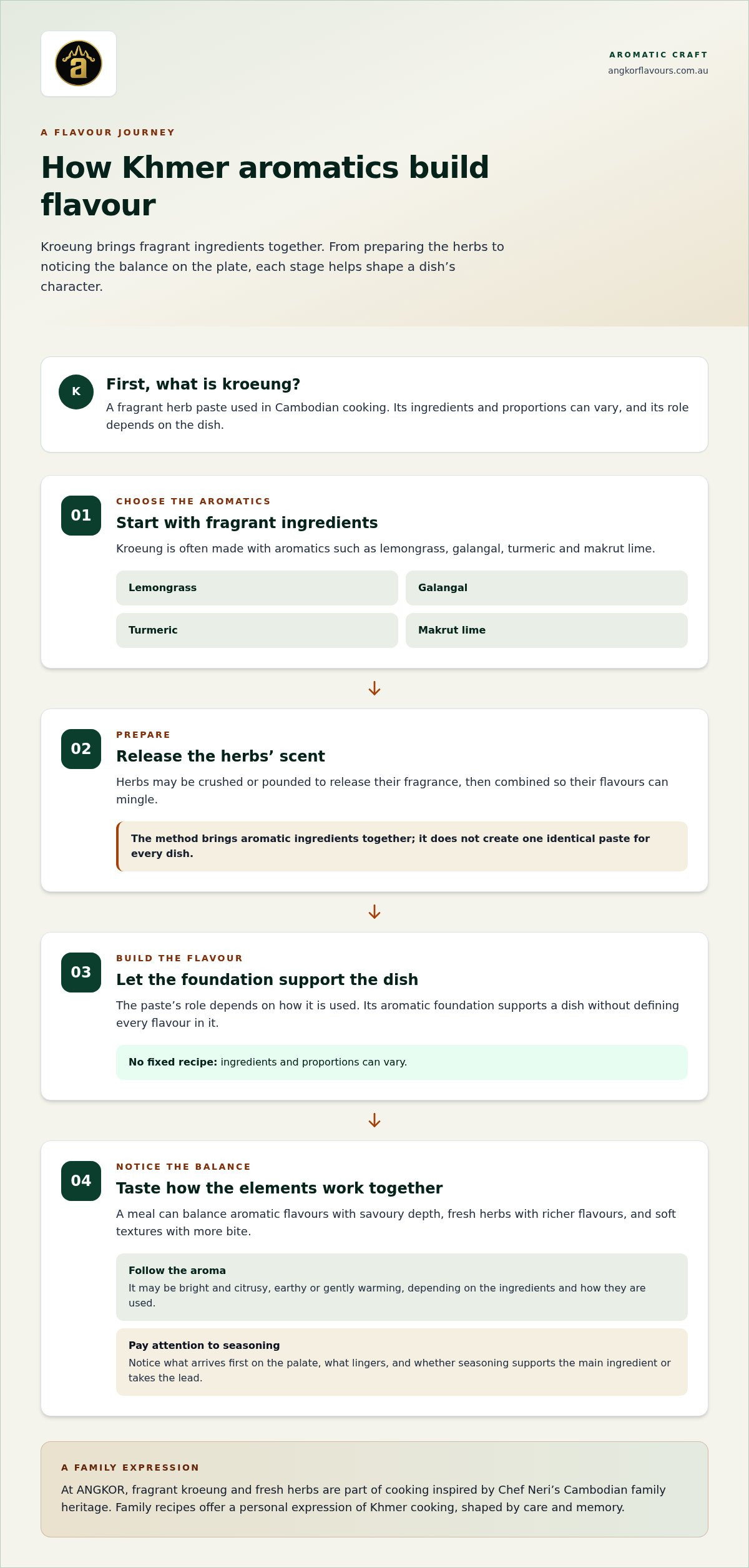
Kroeung is a fragrant herb paste used in Cambodian cooking, often made with aromatics such as lemongrass, galangal, turmeric and makrut lime to create a fresh, deeply scented flavour foundation. There isn’t one fixed recipe: ingredients and proportions can vary, and the paste’s role depends on the dish. Think of it as a way to bring aromatic ingredients together, rather than a seasoning that tastes identical in every meal.
Preparing aromatics takes attention. Herbs may be crushed or pounded to release their scent, then combined so their flavours can mingle. Depending on the ingredients and how they’re used, the result can be bright and citrusy, earthy or gently warming. That foundation supports a dish without defining every flavour in it.
At ANGKOR, fragrant kroeung and fresh herbs sit within a cooking story inspired by Chef Neri’s Cambodian family heritage. Family recipes are a personal expression of that connection, shaped by care and memory. They offer a glimpse into one family’s approach to Khmer cooking.
Balance, texture and the pleasure of a shared meal
A satisfying meal often has contrast. Aromatic flavours may meet savoury depth; soft textures can sit alongside something with more bite. Fresh herbs can bring a lively lift to richer flavours. These are helpful ways to think about balance when exploring a menu.
As you taste, notice what arrives first on the palate and what lingers. Is the aroma herbal, citrusy or earthy? Does the seasoning support the main ingredient or take the lead? Paying attention to these details can make a menu easier to explore, even if the dish names are new to you. You don’t need specialist knowledge; curiosity is enough.
Sharing dishes can make a meal feel generous and relaxed. A group might choose several plates to experience different flavours together, while a solo diner or couple can enjoy a dish at their own pace. If you’d like to see how ANGKOR brings these aromatic ideas to its cooking, explore ANGKOR’s Khmer menu.
What to try first: signature Khmer dishes at ANGKOR
A first Khmer meal is easier to choose when you can picture what’s on the plate. ANGKOR’s signature dishes offer different starting points, from a coconut curry with fragrant kroeung to wok-seared beef and a family-inspired chicken dish. Use the descriptions below to choose a flavour profile that appeals, then follow your curiosity. It’s a welcoming way to explore authentic khmer food melbourne without needing to know every dish already.
Savoury signatures: Fish Amok, Beef Loc Lac and My Grandmother’s Dish
Each dish has its own character. The ingredients below follow ANGKOR’s descriptions, while the suggestions help match a dish to the kind of meal you enjoy.
| Dish | Character and ingredients | A good first choice if you… |
|---|---|---|
| Fish Amok | Mackerel in coconut curry with kroeung, Chinese broccoli and peanuts. | Want to try a fish dish with fragrant aromatics and a coconut curry base. |
| Beef Loc Lac | Wok-seared marinated beef with mixed salad, onions and a fried egg. | Enjoy beef served with fresh salad and a familiar egg topping. |
| My Grandmother’s Dish | Marinated free-range chicken with salad, mint and grandmother’s dipping sauce. | Like a chicken dish with fresh accompaniments and a family-inspired touch. |
For a fragrant curry, start with Fish Amok. Its ingredients bring together coconut curry and kroeung with mackerel, Chinese broccoli and peanuts. Beef Loc Lac offers a different combination: marinated beef, mixed salad and onions, finished with a fried egg. If you’re drawn to a dish with a personal story, My Grandmother’s Dish pairs marinated free-range chicken with salad, mint and grandmother’s dipping sauce.
Let the ingredients guide you instead of trying to guess what a dish should taste like. The descriptions give you a useful starting point, while each plate brings its own experience. If you’re sharing a meal, choosing different signatures is a lovely way to compare flavours at the table.
Finish with a traditional sweet: Black Rice Pudding
Leave room for Black Rice Pudding, ANGKOR’s Khmer dessert. Its deep colour makes a striking contrast to savoury dishes, and it’s a sweet way to round out your meal. For more background on this dessert, explore ANGKOR’s article about Traditional Black Rice Pudding.
Whether you begin with fish, beef or a family-inspired chicken dish, these signatures make choosing straightforward. Pick the ingredients that appeal and let the meal unfold one plate at a time.
How to choose an authentic Khmer dining experience in Melbourne
A cuisine label can help you find a restaurant, but it can’t tell you the whole story. For a first visit, look for three things together: a clear connection to Khmer cooking, specific dishes you can picture, and explanations that make new names approachable. This gives you a practical way to explore authentic khmer food melbourne without treating authenticity as a rigid checklist.
Look beyond a cuisine label on a restaurant listing
Listings are useful for discovery, but a category such as “Cambodian” or “Khmer” is only a starting point. Read the menu and venue story. Do they name particular dishes and describe their ingredients? Does the restaurant share how its cooking connects with family, heritage or place? Those details offer richer context than a label alone, while recognising that one menu can’t represent every Cambodian tradition.
Authenticity isn’t a pass-or-fail test. Cambodian food traditions are varied, and a family recipe is one expression of that heritage, not a definition of the whole cuisine. Consider the experience as a whole: whether the menu is thoughtfully explained, whether the cooking has a discernible story, and whether the welcome makes you feel comfortable exploring the dishes.
At ANGKOR Cambodian Flavours in West Melbourne, Chef Neri’s Cambodian family heritage informs the venue’s family-inspired cooking. That story gives diners a specific point of connection. It’s one locally rooted way to encounter Khmer food, with dishes and hospitality brought together in a neighbourhood dining setting.
Choose dishes that make a first visit feel easy
Start with a signature dish that has a clear description, rather than trying to decode unfamiliar names on their own. Ingredient lists can help you match a dish to what you enjoy: fish with coconut curry, beef with salad and a fried egg, or marinated chicken with mint and dipping sauce. These clues give you a comfortable starting point, even if they don’t capture every nuance.
If you’d like more detail before choosing, the Fish Amok and Beef Loc Lac guides offer dish-specific context. Use them to understand the named ingredients and preparations, then decide which sounds most appealing. A helpful explanation at the table can add another layer, such as what makes a dish distinctive or how its ingredients come together.
Let place, craft and hospitality sit alongside the menu as you make your choice. A meaningful meal isn’t only about ordering the “right” dish; it’s also about understanding something of its story and feeling at ease as you explore. To experience ANGKOR’s family-inspired Khmer cooking in West Melbourne, plan a visit to ANGKOR.
Experience authentic Khmer food at ANGKOR in West Melbourne
A memorable meal brings more than flavour to the table. There’s the story behind a recipe, the care in its preparation and the welcome that makes you want to linger. At ANGKOR Cambodian Flavours, these threads meet in an independently owned Khmer dining venue inspired by Chef Neri’s Cambodian family heritage. For diners seeking authentic khmer food melbourne, it’s a chance to experience one family’s connection to Cambodian cooking in West Melbourne.
Family-inspired Khmer cooking at 389 Spencer Street
Find ANGKOR at 389 Spencer Street, West Melbourne, near Southern Cross and Marvel Stadium. Its location puts Khmer dining within reach of the city, while the food offers a personal introduction to Cambodian cooking. Chef Neri’s heritage informs the venue’s cooking and hospitality, with family-inspired recipes sharing a story through the dishes.
The signature dishes show different sides of that story. Fish Amok brings together mackerel, coconut curry, kroeung, Chinese broccoli and peanuts. It’s a distinct starting point if you’re curious about aromatic ingredients in a Khmer dish. My Grandmother’s Dish pairs marinated free-range chicken with salad, mint and grandmother’s dipping sauce, carrying its family connection in its name. One is a signature expression of Khmer cooking; the other makes the personal heritage behind the menu especially clear.
A restaurant’s menu can be rooted in heritage and still be one particular expression of it. ANGKOR’s dishes invite you to explore Khmer food through Chef Neri’s family story, while recognising the breadth of Cambodia’s cooking traditions beyond any single venue.
Dine in, share a meal and plan your visit
ANGKOR welcomes diners for dine-in meals Tuesday to Sunday. Whether you’re trying Khmer food for the first time or returning to familiar flavours, take time to enjoy the dishes and the stories behind them. For a group gathering, communal Event Feasts bring people together around a shared meal.
If you’re not sure where to begin, let the dish descriptions guide you. Choose the ingredients and preparations that appeal, then take your time with each plate. A fragrant curry, a family-inspired chicken dish or a table shared with friends can each make a welcoming first encounter. The pleasure is in tasting, noticing and enjoying the meal together.
Visit ANGKOR for your next West Melbourne meal and explore its Khmer menu. You’ll find a warm introduction to Khmer cooking, shaped by family heritage and served with care.
Make your next meal a taste of Khmer heritage
You don’t need to master a new cuisine before you enjoy it. Let curiosity lead: choose a dish that catches your eye, notice its aromas and ingredients, and make space for the story behind the food. That’s a welcoming way to experience authentic khmer food melbourne, with each meal offering its own perspective on Cambodian cooking.
At ANGKOR, Chef Neri’s Cambodian family heritage informs the restaurant’s story. Fish Amok, Beef Loc Lac and My Grandmother’s Dish each offer a different introduction to the menu, from a distinctive Khmer signature to a recipe with a family connection. You might arrive with one dish in mind and leave with a new favourite, or share the experience around the table with people you love.
Make time for a meal in West Melbourne and follow your appetite. Visit ANGKOR and explore the Khmer menu. There’s always room at the table for a curious first taste.
Frequently Asked Questions
Is Khmer food spicy?
Khmer cooking isn’t defined by one fixed heat level; warmth depends on a dish’s ingredients and preparation. Aromatic herbs can create vivid flavour without intense chilli. If you’re exploring authentic khmer food melbourne and prefer gentler heat, read the menu description and ask staff for guidance. ANGKOR describes Fish Amok as a fragrant steamed coconut curry with kroeung, an aromatic example rather than a guide to the heat of every Khmer dish.
What is prahok in Cambodian food?
Prahok is a fermented fish paste used in some Cambodian cooking, where it can contribute a distinctive, savoury depth. Its flavour can be assertive, but its role varies: recipes and family cooking practices differ, and it isn’t present in every Khmer dish. If you’re curious about a particular plate, use its menu description to see what’s included rather than assuming prahok is part of the cuisine as a whole.
What is num banh chok?
Num banh chok is a Cambodian rice-noodle dish often served with a fish-based curry sauce and fresh accompaniments. The exact recipe can differ between regions and households, so the name may describe variations rather than one identical preparation. It’s a useful example of the breadth of Cambodian food, especially everyday dishes beyond dinner menus. It’s distinct from the ANGKOR signature dishes discussed in this guide.
Are Khmer and Thai food the same?
No. Khmer and Thai cuisines have distinct histories and food traditions, even though neighbouring cultures may share influences or use some familiar ingredients. It’s more helpful to approach a Khmer dish through its own name, ingredients and preparation than to judge it as a version of Thai food. For diners in West Melbourne, reading a menu description can offer a clearer sense of what makes each dish distinctive.
What does a typical Cambodian breakfast include?
There isn’t one breakfast that represents every Cambodian household. Depending on family and region, people may eat rice-based dishes or noodle soups, among other foods. These everyday meals are a reminder that Cambodian cuisine extends beyond the dishes commonly encountered at dinner. A selection of evening signatures can’t show the full range of meals eaten across Cambodia.
What does the word Khmer refer to?
Khmer refers to Cambodia’s majority ethnic group and its official language, and it’s also used in cultural contexts. In food writing, “Khmer cuisine” commonly means the culinary traditions of Cambodia, so diners may also see “Cambodian food” used for the same broad category. Neither term points to a separate restaurant type. Individual recipes and customs still vary between regions, families and kitchens.


